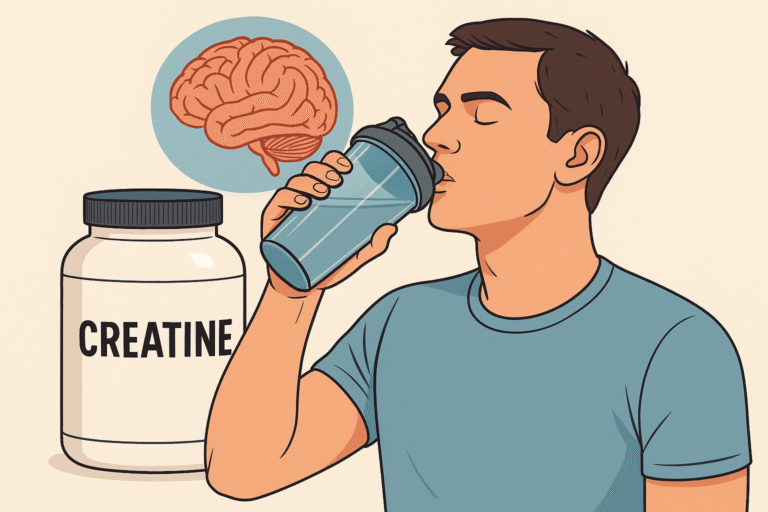
When most people hear the word creatine, they think of gyms, weightlifting, and muscle strength.
But over the past two decades, research in neuroscience has revealed a completely different and far more fascinating picture:
Creatine is one of the most important molecules for brain energy, cognitive clarity, mental endurance, and emotional stability.
In many people, creatine has a surprising effect:
sharper thinking, reduced nervousness, smoother focus, and less “brain shutdown” during stress or long hours of work.
This article explains why creatine affects the brain so strongly, and why this effect remains one of the most underrated discoveries in modern neuroscience.
✅ Creatine’s Real Mission: Powering the Brain
Your brain is the most energy-demanding organ in your body.
It uses 20–25% of all the energy you produce — even while resting.
Yet the brain stores only a tiny amount of ATP, the molecule that powers every thought, decision, emotion, and movement.
To survive, the brain depends on a fast “emergency battery” called phosphocreatine, made from creatine.
Phosphocreatine instantly restores ATP whenever the brain runs low.
Without this system, neurons would fatigue quickly.
This is why creatine is fundamentally important not just for muscles, but for mental performance.
✅ Why Creatine Can Dramatically Improve Mental Energy
When the brain doesn’t have enough phosphocreatine, ATP levels drop earlier and faster.
This leads to:
- mental fatigue
- difficulty concentrating
- reduced motivation
- slower speech and thinking
- evening “crashes”
- irritability or nervousness
- the feeling of “shutting down under cognitive load”
For some people, this is subtle.
For others, it’s life-changing when fixed.
Creatine restores ATP stability inside neurons, which can create a deep shift:
✅ more clarity
✅ more cognitive endurance
✅ fewer “drains” during work
✅ greater emotional resilience
✅ smoother speech and decision-making
✅ less internal tension or overwhelm
This is not stimulation — it’s energy restoration.
✅ Creatine, Glutamate, and GABA: The Calm–Clear Balance
One of the most important discoveries in neuroenergetics is the relationship between ATP levels and the balance between:
- glutamate — the brain’s excitatory “gas pedal”
- GABA — the brain’s inhibitory “brake”
Clearing glutamate from synapses requires a large amount of ATP.
If ATP is low:
- glutamate accumulates
- neurons become hyperactive
- GABA signaling weakens
This produces a state that feels like:
- nervousness
- overstimulation
- restlessness
- “wired but tired”
- inability to calm down mentally
Creatine strengthens the brain’s energy buffer, which supports healthy glutamate clearance and stable GABA function.
The result is a calm, clear, focused mind — not sedated, not stimulated.
Many people describe this as:
“My brain feels stable and less reactive.”
✅ Creatine vs Mental Stress, Overload, and Fatigue
People under high cognitive load (e.g., programmers, students, analysts, or anyone with intense mental work) burn ATP very rapidly.
When ATP falls, the brain begins to:
- slow down
- misfire
- overload
- feel overwhelmed
- shut down higher functions (like speech or problem-solving)
Creatine’s phosphocreatine system keeps ATP from collapsing under stress, allowing the brain to maintain performance even during heavy use.
This explains why some individuals feel a profound difference in:
✅ productivity
✅ stability
✅ clarity
✅ motivation
✅ evening mental stamina
The brain simply stops running out of energy.
✅ Creatine and Aging: Energy Support for the Aging Brain
Research on older adults shows improvements in:
- mental energy
- working memory
- processing speed
- resistance to mental fatigue
- mood and motivation
- overall cognitive performance
Aging naturally reduces mitochondrial efficiency and phosphocreatine stores.
Creatine partially reverses this decline, helping restore energy flow in both the brain and muscles.
✅ The Most Underrated Cognitive Molecule
Creatine is not a stimulant.
It doesn’t affect hormones or neurotransmitters directly.
Its power comes from something more fundamental:
✅ It stabilizes the brain’s energy supply.
When the brain finally has enough ATP, everything becomes easier:
- thinking
- speaking
- decision-making
- stress management
- learning
- emotional control
For some people, this feels like an internal “reset.”
✅Vegetarians and Vegans Often Feel the Mental Effects More Strongly
One of the most consistent findings in research is that vegetarians and vegans experience the strongest cognitive response to creatine.
The reason is simple:
- Creatine is obtained mostly from meat and fish.
- Plant-based diets contain almost zero creatine.
- The body can synthesize some creatine, but not enough to fully saturate the brain.
As a result, people who do not eat meat often have:
- lower baseline brain creatine
- lower phosphocreatine storage
- reduced ATP buffering
- faster mental fatigue under cognitive load
When these individuals begin creatine supplementation, their brain energy system finally reaches full saturation — sometimes for the first time.
This leads to much more pronounced mental effects, such as:
✅ sharper clarity
✅ faster thinking
✅ stronger motivation
✅ reduced evening fatigue
✅ calmer and more stable mood
✅ better cognitive endurance
Some studies show that vegetarians improve cognitive performance significantly more than meat-eaters when taking creatine.
In other words:
The less creatine you get from your diet, the more your brain may respond to it.
✅ Conclusion: The Hidden Cognitive Power of Creatine
Despite its reputation as a sports supplement, creatine is fundamentally a brain supplement — one that supports ATP recycling, neural stability, and mental endurance.
It is scientifically clear that creatine plays a central role in:
- cognitive clarity
- emotional regulation
- stress resilience
- neuroprotection
- healthy aging
- balancing glutamate and GABA
- maintaining high-level mental performance
When the brain’s energy system finally works as it should, the mind feels clear, calm, stable, and fully awake — often for the first time in years.
Creatine may be one of the most misunderstood and underappreciated tools for supporting modern cognitive health.